Book Categories:

News
New Citroën 2CV Electric 2026: Price, Features and Pakistan Update

Share:
Share:
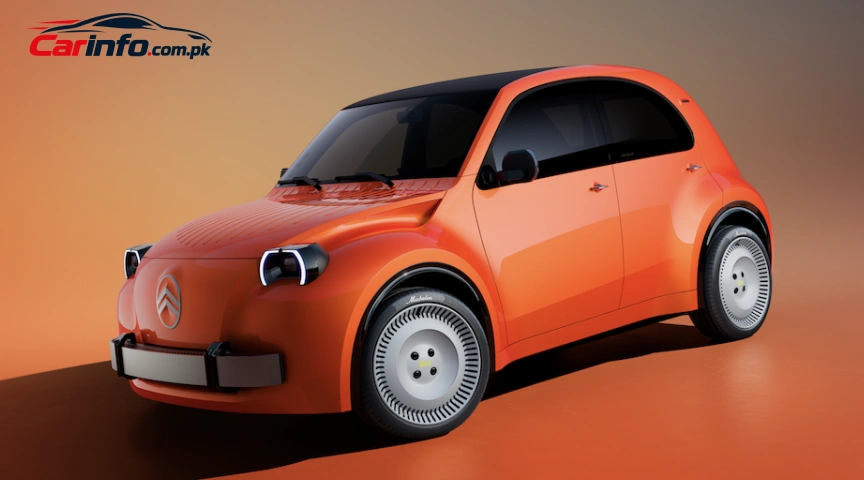
The new Citroën 2CV electric concept brings one of France’s most recognisable cars into the modern electric vehicle era. Unveiled at the 2026 Paris Motor Show, the concept combines the original 2CV’s distinctive character with contemporary styling, a minimalist cabin and an affordable electric mobility goal.
According to Citroën’s official announcement, a production model inspired by the concept is planned for introduction by 2028, with a targeted starting price of around €15,000 in Europe. However, the company has not yet confirmed final production specifications, battery capacity, driving range or a launch date for Pakistan.
For Pakistani buyers interested in affordable electric cars, the new Citroën 2CV is worth following. Its eventual appeal will depend on its final price, import costs, charging requirements and whether the manufacturer makes it available in Pakistan.
The official price of the new Citroën 2CV in Pakistan has not been announced. The vehicle remains a concept, and its expected European starting price should not be treated as a confirmed Pakistani retail price.
Citroën is targeting a starting price of approximately €15,000 for the future production model. The vehicle is intended to offer a more accessible entry into electric motoring in Europe.
| Price detail | Current information |
|---|---|
| Expected European starting price | Around €15,000 |
| Pakistani ex-factory price | Not announced |
| Pakistani on-road price | Not announced |
| Expected production model | By 2028 |
| Availability in Pakistan | Not confirmed |
| Booking and delivery dates | Not announced |
The final Pakistani price would depend on several factors, including the exchange rate, import duties, applicable taxes, shipping expenses, registration charges and the vehicle’s final specification.
The European target price is not a reliable estimate of its total cost in Pakistan. Importing a small electric car can involve substantial additional expenses, so buyers should wait for an official local price or a properly documented import quotation.
The following table separates the information announced by Citroën from technical details that remain unconfirmed.
| Specification | Details |
|---|---|
| Vehicle name | Citroën 2CV Concept |
| Model category | Compact electric car |
| Vehicle status | Concept |
| Powertrain | Fully electric |
| Length | 3,760 mm |
| Target vehicle weight | Around 1,000 kg |
| Battery capacity | Not announced |
| Driving range | Not announced |
| Electric motor output | Not announced |
| Torque | Not announced |
| Transmission | Final production specification not confirmed |
| Charging time | Not announced |
| European target starting price | Around €15,000 |
| Planned production model | By 2028 |
| Pakistani launch | Not confirmed |
Citroën has confirmed the concept’s dimensions and electric powertrain direction, but detailed performance figures have not been released. The approximately 1,000 kg weight is a target reported by Top Gear, rather than a confirmed final production figure.
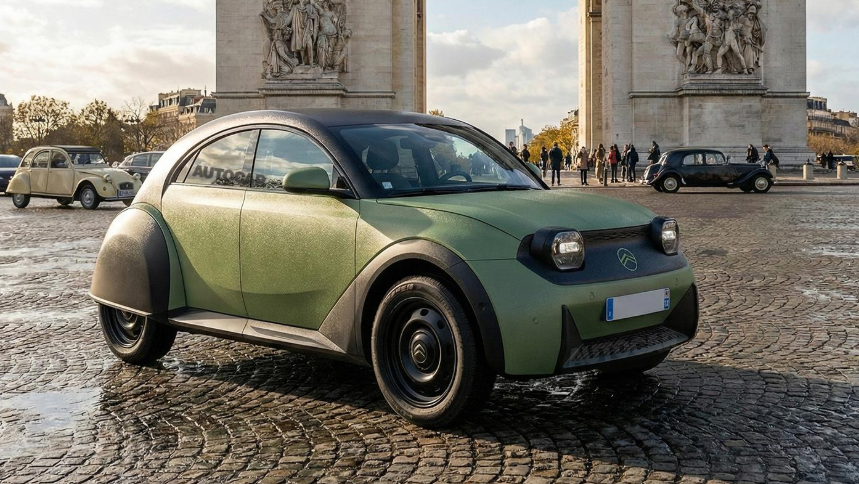
The original Citroën 2CV became famous for its simple design and practical approach to everyday transport. The new concept draws inspiration from that history without attempting to reproduce the older car exactly.
Its compact proportions and rounded body give it a distinctive appearance among modern electric vehicles.
Key exterior highlights include:
The design approach combines familiar details with new styling elements, helping the vehicle retain its character without looking like a restored vintage car.
The concept’s interior follows the same philosophy as its exterior: keep everyday functions simple while adding modern technology where it is useful.
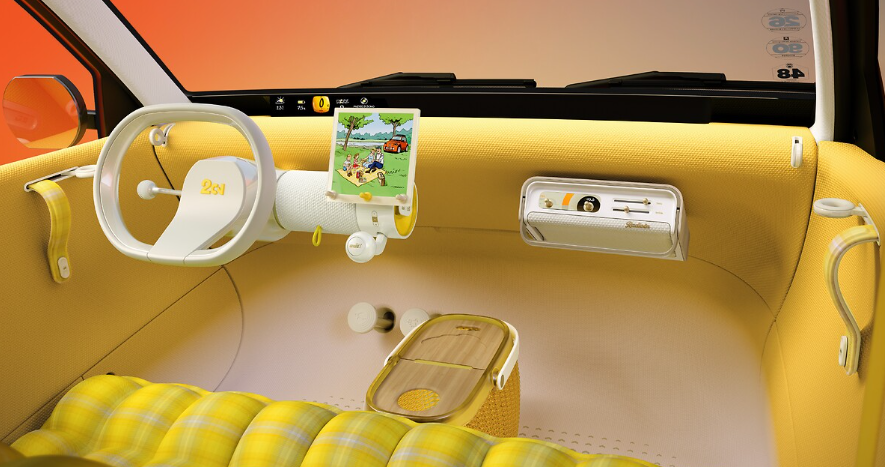
Instead of a conventional dashboard layout, the concept places several controls and displays around a central cylindrical structure. The design includes a single-spoke steering wheel, a drive selector and an 8-inch touchscreen.
A slim display ahead of the driver presents essential driving information.
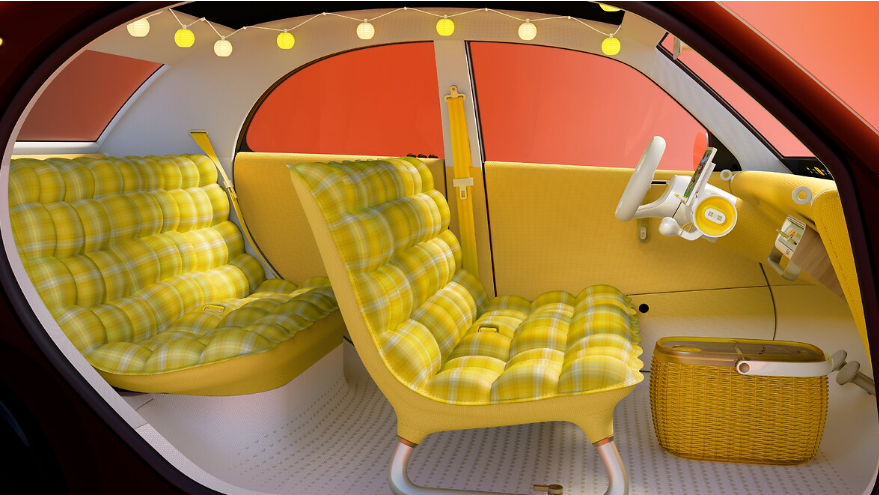
The interior includes a removable storage basket in the area where many modern cars have a centre console. Citroën also features a detachable portable sound system called Radioën, adding a practical and playful element to the cabin.
The concept uses colourful interior details and graphics inspired by comic-book artwork. Other touches reference the original 2CV, including storage spaces shaped around the idea of carrying everyday farm produce.
These features are part of the concept’s design presentation. Their availability in a production car will depend on the final specification.
Citroën has confirmed that the future 2CV-inspired production car is intended to be fully electric. However, the company has not yet published the final motor output, battery capacity or official driving range.
This means buyers should not rely on unofficial performance figures when comparing the concept with electric cars already available in the market.
| Electric vehicle detail | Status |
|---|---|
| Power source | Battery-electric |
| Battery size | Not confirmed |
| Motor power | Not confirmed |
| Maximum torque | Not confirmed |
| Official range | Not confirmed |
| AC charging speed | Not confirmed |
| DC fast charging | Not confirmed |
| Charging time | Not confirmed |
Top Gear reports that Citroën is targeting a relatively low vehicle weight and a modest driving range to help keep the battery and vehicle affordable. Its article mentions a possible range of around 170 miles as an editorial estimate, not an official Citroën figure.
For Pakistani motorists, the final range will matter considerably. Urban commuters may prioritise low running costs and easy charging, while drivers who regularly travel between cities will need dependable range, accessible charging points and reasonable charging times.
Pakistan’s electric vehicle market has different requirements from the European market where Citroën is targeting this model. Local buyers need to consider not only the purchase price but also charging access, electricity costs, parts availability and after-sales support.
The concept’s short body could make it suitable for congested streets and tight parking spaces. Its final passenger capacity, boot space and ground clearance will need to be confirmed before its suitability for Pakistani roads can be assessed properly.
An electric car can cost less to run per kilometre than a petrol car, depending on electricity tariffs, charging efficiency and the comparable petrol vehicle’s fuel consumption.
However, the Citroën 2CV’s actual running costs cannot be calculated reliably until its battery, efficiency and charging specifications are available.
Home charging could be convenient for owners with a suitable parking space and electrical installation. People living in apartments or using street parking may depend on public charging facilities.
Buyers should also check whether the vehicle supports locally available charging equipment and charging standards if it eventually reaches Pakistan.
Citroën has not confirmed local availability for this model. Without an established service network, owners of an imported vehicle could face longer waits for replacement parts and specialist repairs.
Warranty coverage and battery servicing would also need to be confirmed before purchasing.
The targeted European starting price of €15,000 is intended to make the production car accessible in its home market. It does not guarantee that the vehicle would be inexpensive in Pakistan.
Import duties, taxes, exchange-rate changes and local distribution costs could substantially increase the final price.
Because the vehicle is still a concept, these points reflect its announced design direction and the questions buyers should consider, rather than a completed road test.
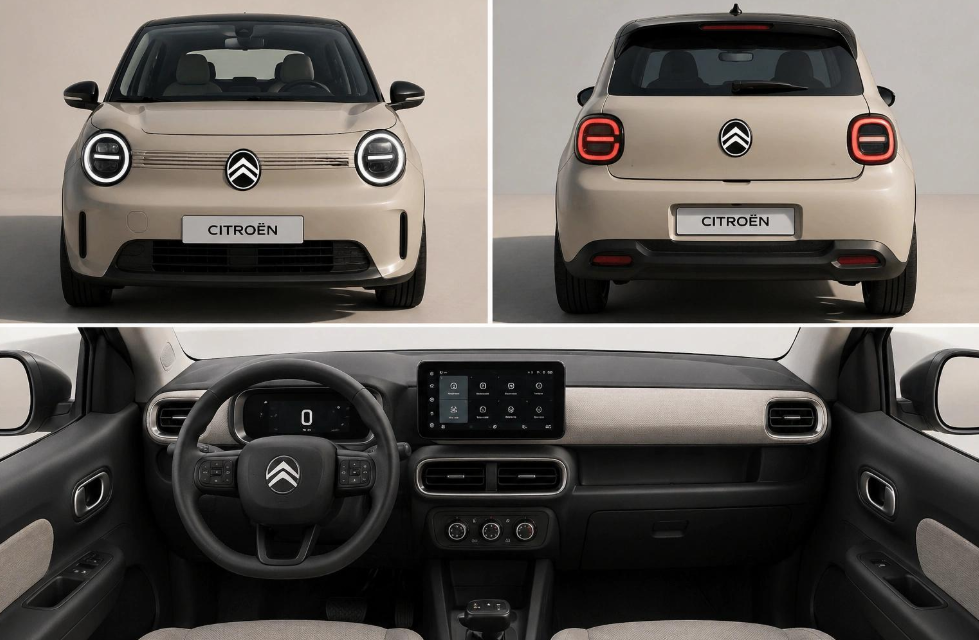
Citroën plans to position the future 2CV-inspired model between its Ami and C3 offerings. It is intended to provide a more conventional small-car experience while keeping affordability and simplicity central to its design.
For Pakistani buyers, it would be premature to declare it a direct competitor to a specific locally sold electric car because its production specifications, price and market availability are not yet known.
When the final model is announced, buyers should compare the following points:
| Buying consideration | Why it matters |
|---|---|
| Purchase price | Determines affordability after taxes and import costs |
| Real-world range | Shows how far the car can travel between charges |
| Charging compatibility | Helps establish whether it can be charged conveniently in Pakistan |
| Battery warranty | Affects long-term ownership risk |
| Ground clearance | Important for uneven roads and speed breakers |
| Passenger and luggage space | Determines everyday practicality |
| Spare parts and service | Influences repair costs and downtime |
| Resale value | Matters for long-term ownership costs |
Until more details are released, Pakistani buyers should treat the 2CV as an upcoming international EV concept rather than a confirmed alternative to vehicles already available locally.
The concept may interest drivers who want a small electric car with distinctive styling and a simple approach to everyday transport. It is also worth watching for people who prefer compact city cars over larger electric SUVs.
However, buyers who need a car soon should not base a purchase decision on the concept alone. The expected production timeline extends to 2028, and Citroën has not confirmed a Pakistani launch.
Before making a decision, consider your daily travel distance, access to home or public charging, budget and access to authorised servicing.
If you need a vehicle in Pakistan today, compare currently available cars using verified local prices, warranty terms and after-sales support rather than assuming that an international concept will arrive locally.
Citroën is targeting a starting price of around €15,000 for the future production model in Europe. The final retail price has not been confirmed, and no price for Pakistan has been announced.
Citroën says the production model inspired by the concept is planned for introduction by 2028. A specific on-sale date has not been confirmed.
Yes. Citroën has presented the 2CV Concept as a fully electric vehicle. The production model’s battery capacity, motor output and driving range have not yet been confirmed.
There is no confirmed Pakistani launch, official local price or booking schedule in the information currently available. Buyers should wait for an announcement from the manufacturer or a verifiable authorised distributor.
Citroën has not announced an official driving range. Top Gear has discussed approximately 170 miles as a possible target, but this is an estimate rather than a confirmed manufacturer specification.
The concept measures 3.76 metres, or 3,760 mm, in length. Final production dimensions may change.
Its affordability in Pakistan cannot yet be determined. The final cost will depend on the production price, import arrangements, taxes, exchange rates and local support.
The new Citroën 2CV electric concept brings a familiar automotive name into the growing market for compact electric cars. Its 3.76-metre body, distinctive retro-inspired design and targeted European starting price of around €15,000 make it an interesting upcoming model.
For Pakistan, though, the most important details remain unconfirmed. There is no official local price, launch date, battery specification or confirmed service arrangement. Its suitability for Pakistani buyers will become clearer once Citroën reveals the production version.
Visit CarInfo.com.pk for more car prices, specifications, reviews and electric vehicle updates relevant to Pakistani motorists.